
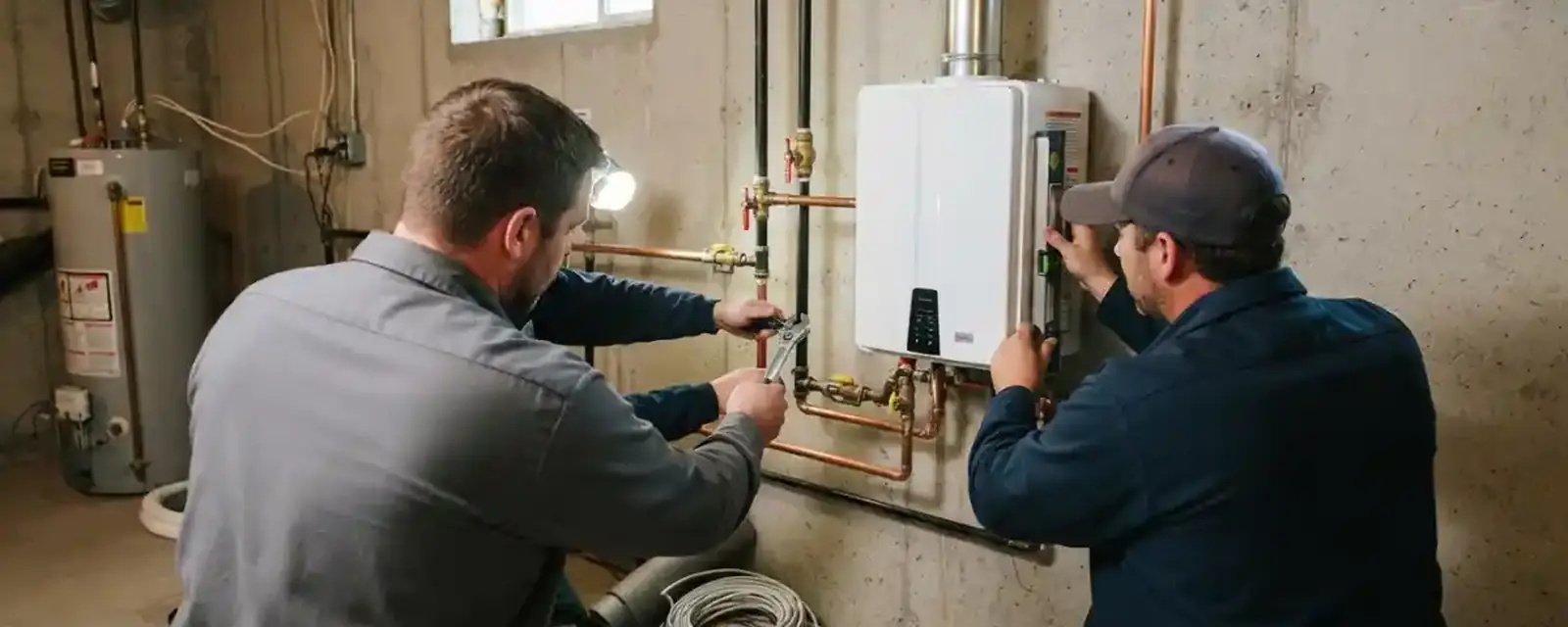
Does a tankless water heater use gas?
Some do and some do not. Gas tankless models burn natural gas or propane through a heat exchanger, and they need a gas line sized for the higher burner load plus a vent that carries exhaust outdoors. Electric tankless models use heating elements and need heavy electrical service.
That gas-or-electric choice drives the rest of the project. A gas unit may mean upsizing the gas line. An electric unit may mean a new breaker and wire run, and on a smaller panel it may not fit at all. We check both before recommending a model.
Benefits and limits to weigh before you buy
| Feature | Tankless | Standard tank |
|---|---|---|
| Hot water supply | Continuous while flow is within the unit's limit | Limited to tank volume, then recovery. |
| Space | Small, wall mounted | Floor space needed. |
| Upfront cost | Higher | Lower. |
| Maintenance | Annual flush recommended | Occasional flush, anode check. |
| Peak demand | May struggle if many fixtures run at once | Handles bursts until tank empties. |
If your tank has just failed, compare with replacement options. Sizing a tankless unit to the household matters more than the brand.
Flush and descale: the maintenance that keeps it working
Tankless units depend on a heat exchanger with narrow passages. Mineral scale narrows them and the unit works harder, throws error codes or shuts down. Flushing runs a descaling solution through the unit to clear that.
Beaverton's water is soft, typically 1.5 to 3 grains per gallon according to the City's report, so scaling is slower here than in hard-water cities. Annual flushing is still the standard recommendation, and checking the inlet screen for debris is cheap. Your manufacturer's manual sets the interval.
Freezing is another risk. Units mounted outdoors or in unheated garages need freeze protection. Heat tape is a common add-on, and manufacturer instructions decide what is allowed.
Installing a tankless unit: what changes in your house
- 1
Check gas, power and venting.
The plumber measures gas line size or the electrical panel and plans the vent.
- 2
Mount and pipe the unit.
Isolation valves for flushing are installed so service is easy later.
- 3
Connect vent, gas or electric.
Condensing models also need a condensate drain.
- 4
Permit, test and set up.
Oregon requires plumbing permits for water heaters, and we test temperature, flow and combustion before leaving. Venting and gas piping follow the Oregon Plumbing Specialty Code, which is based on the Uniform Plumbing Code (UPC), and the manufacturer's instructions.
Repair: error codes, cold water sandwich and no ignition
Common faults include scale, a dirty inlet filter, a failed igniter or flame sensor, a clogged vent and flow sensor trouble. Many show as an error code on the display, and the manual translates them.
A burst of cold water between hot flows is often a feature of the unit and not a fault, and sometimes a small recirculation setup helps. If your unit is old and failing repeatedly, we can compare repair with installing a new one.
What affects the price
- Unit capacity. More fixtures need a larger unit.
- Fuel upgrades. Gas line or electrical capacity changes add cost.
- Venting. Direct vent runs vary in length.
- Permit and code items. Handled with the job.
- Flush service. Priced separately and usually quick.
Tankless work is a planned homeowner expense, and some utilities offer rebates, so check yours. We give a clear price before starting.
Book a flush or a repair
Flushing is quick when the unit has isolation valves, and a service visit also checks the inlet screen, the vent and the error history. A same-day window is offered when one is open.
Tankless unit throwing an error code or due for a flush? Call to book a plumber.
Tankless water heater questions
Manufacturers generally recommend annual flushing. Beaverton's soft water slows scale, but the flush also clears debris from the inlet screen, so follow your manual.
Often yes, but gas line size, venting and electrical capacity decide. We check each before quoting.
If it is outdoors or in an unheated space, freeze protection is important. Heat tape is a common choice and the manufacturer's installation guide sets the rules.
Common causes are scale, a dirty filter, ignition faults or venting problems. The code points to the area, and a plumber confirms.
Oregon requires plumbing permits for water heaters. We handle the permit when we install.