
Water leaking inside the house: what to do first
- If water is actively flowing through a ceiling or wall, close the main shutoff and call.
- Place a bucket under drips and punch a small relief hole in a bulging ceiling only if you can do it safely.
- Turn off power to any room where water is dripping through fixtures or outlets.
- Photograph the stain and its spread over a few hours, because the pattern helps trace the source.
Water coming through a ceiling or wall? Call now.
The meter test: is something leaking?
Start with your water meter. Turn off every fixture and appliance that uses water, then look at the leak indicator on the meter, often a small dial or triangle. If it keeps moving, water is going somewhere you cannot see.
The City of Beaverton has web pages on water meters, leaks and a leak adjustment policy. Check the policy for how a bill adjustment works. It is worth reading before a leak, because a documented repair by a plumber often matters for any adjustment.
Where hidden leaks hide and how we find them
| Leak location | Clues | How we trace it |
|---|---|---|
| Under a slab | Warm floor spot, hissing, bill spike | Acoustic listening and pressure test. |
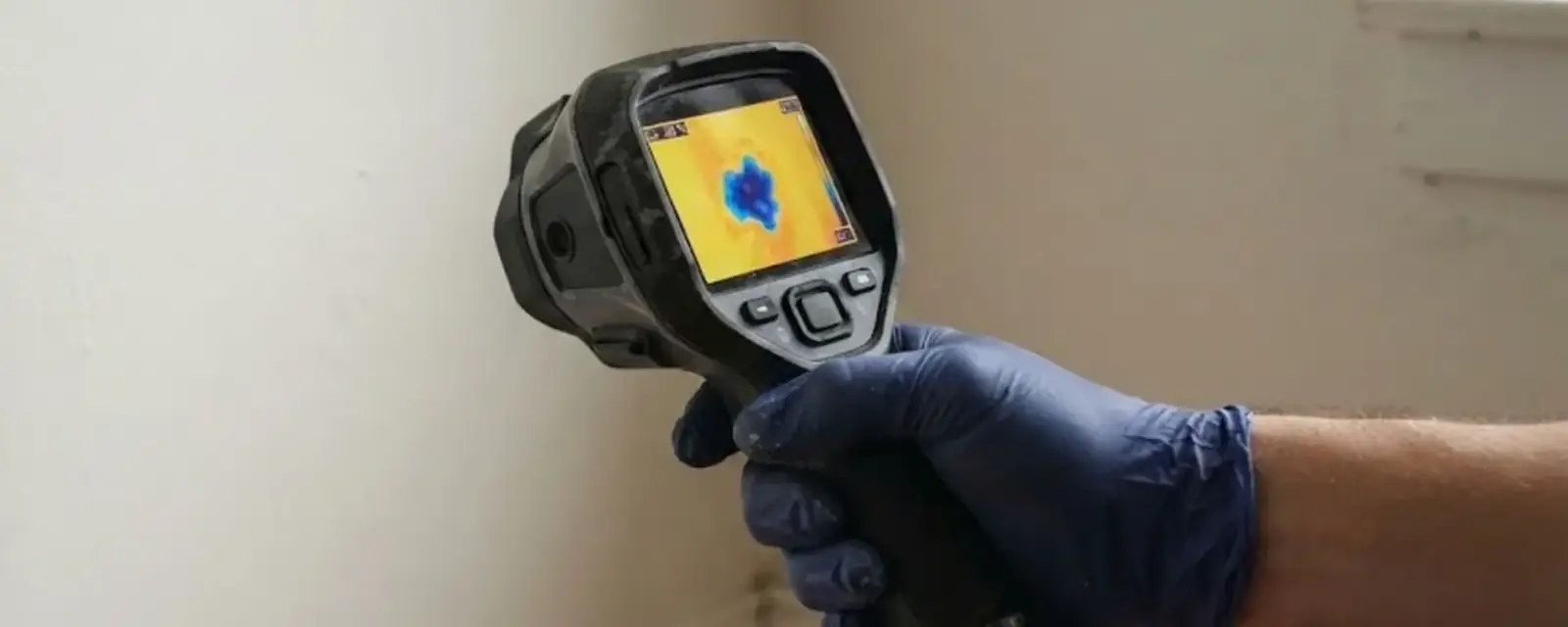
| Inside a wall | Stain, mold smell, sound of running water | Moisture meter and thermal imaging. |
| Ceiling or attic | Stains below a bathroom or roof | Moisture mapping and fixture testing. |
| Buried supply line | Meter runs with fixtures off, wet ground | Pressure test, listening, locator. |
| Toilet or fixture | Water bill drift | Dye test and fixture check. |
The tools name what we use, and the plumber explains each. Finding the leak without opening walls blindly is the point. Once found, repair follows, for example burst pipe repair or water service line work.
High water bill with no visible leak
A bill that rises without any change in use is a classic sign. The usual suspects are a running toilet, a failing irrigation valve, a leak in a buried line or a leak in a wall.
- 1
Read the meter and check for movement.
With all water off, note the dial for ten minutes.
- 2
Dye test the toilets.
Put a few drops of food coloring in each tank. If color reaches the bowl without flushing, the flapper leaks.
- 3
Check irrigation and outdoor spigots.
A stuck valve can run for days.
- 4
Call for a pressure test.
If the meter still moves, a plumber isolates the house and the line to the street to find which section leaks.
Slab leaks and older Beaverton homes
Beaverton grew from about 6,000 residents in 1960 to more than 50,000 in 1990, and plenty of homes built then have slab or crawlspace supply lines that are now decades old. Water moves through them at constant pressure, and corrosion and settling find the weak spot eventually.
Beaverton's soft water is gentle on pipes compared with hard water. It is not a guarantee, especially for older galvanized lines. If a leak shows up in an old line, ask about whether more failures are likely, which is the question behind repiping. Reroutes and spot repairs are done to the Oregon Plumbing Specialty Code, which is based on the Uniform Plumbing Code (UPC).
Commercial buildings share the same issues. Our crew also handles commercial plumbing leaks outside of business hours.
What affects the price and the insurance picture
- Method. A meter and pressure test costs less than a full survey with imaging.
- Access. Open crawlspaces are simpler than finished slabs.
- Number of suspect lines. More lines mean more isolation tests.
- Repair. Finding a leak and fixing it are priced separately.
- Hours. Emergency hours follow emergency rates, quoted first.
Insurance often covers the resulting damage from a sudden leak but not always the cost of finding it or the pipe itself. Call your insurer early.
Leak detection questions from Beaverton homeowners
Yes. Dispatch is open all hours. If water is actively flowing, close the main shutoff and call, and a plumber is assigned to your address.
Turn off all water, then watch your meter's leak indicator. If it moves, you have a leak somewhere between the meter and your fixtures.
Often yes. Acoustic listening, moisture meters, thermal imaging and pressure tests narrow the source before anything is opened.
The City has a leak adjustment policy page. Ask the water department what documentation it requires, because a plumber's written repair record often helps.
Check toilets with dye, irrigation valves and outdoor spigots first. If those are clear, a pressure test finds buried line leaks.
Yes. We locate slab leaks and explain whether a spot repair or a reroute makes sense. A repipe may be worth a conversation for an old line.