
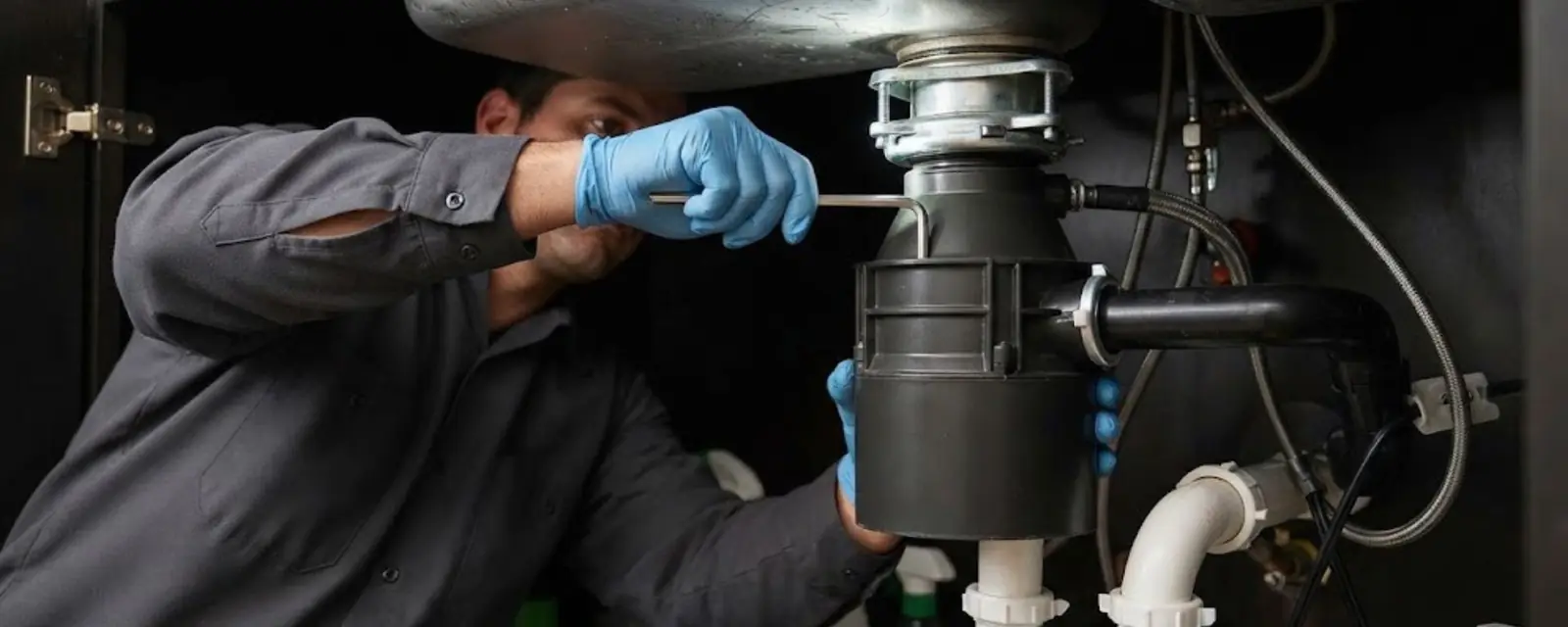
Disposal leaking or sink full of dirty water
- Turn off the disposal switch and unplug it or turn off its breaker before touching anything.
- Never put your hand in the disposal, even when it is off.
- Place a bucket under the leak and close the sink's stop valves if water is flowing from a supply line.
- If the sink backs up even with the disposal off, the clog is in the drain, handled under drain cleaning.
Water pouring from under the sink? Call now.
What the symptoms mean
| Symptom | Likely cause | Fix |
|---|---|---|
| Humming but not spinning | Jammed flywheel | Free it with the hex socket on the bottom and press the reset. |
| Nothing at all | Tripped reset or dead unit | Reset, check the outlet, then test the motor. |
| Leak at the top flange | Failed seal or loose mount | Reseat or replace the mount. |
| Leak from the side or bottom | Cracked housing | Replace the unit. |
| Bad smell | Food residue | Clean and flush the unit. |
| Sink drains slowly | Clog beyond the disposal | Clear the line. |
Double sink with a disposal: how the plumbing is set up
A double bowl sink with a disposal on one side has a tailpiece from each bowl that joins through a continuous waste into a single trap. The disposal discharges into that waste. A dishwasher drain hose usually connects to a port on the disposal, often through a high loop or an air gap so dirty water cannot flow back.
That arrangement is why a clog behind the disposal slows both bowls, and why dishwasher water can appear in the sink. If you are replacing a double sink or adding a disposal, the trap arm, the dishwasher connection and the electrical switch all matter.
Beaverton homes from the 1960s through the 1990s often have single-bowl sinks or older traps, so adding a disposal can mean plumbing changes. We check before quoting. The plumbing side follows the Oregon Plumbing Specialty Code, which is based on the Uniform Plumbing Code (UPC). New hardwired wiring falls under the National Electrical Code (NEC), so a licensed electrician may be needed for it.
Installing or replacing a disposal
- 1
Choose horsepower and mount.
Larger motors grind harder and run quieter. Mount types differ, so we match yours.
- 2
Power and switch.
The unit needs an outlet or a hardwired circuit and a switch you can reach.
- 3
Connect the discharge and dishwasher.
The new unit is connected to the trap and the dishwasher drain, with the knockout plug removed on the dishwasher port.
- 4
Test and show you how to use it.
We run it, check for leaks, and explain what not to put down it.
If the sink also needs a new faucet, see faucet repair.
What not to put down a disposal
Grease and oil are the biggest problem. They coat the pipe wall downstream and harden. Fibrous food such as celery and corn husks, large amounts of rice or pasta, and coffee grounds in bulk also clog. Bones and fruit pits can jam the unit.
Run cold water while you use it and for a bit afterward. Cold water keeps grease solid so it moves through, instead of melting and coating the pipe.
What affects the price
- Repair or replacement. A jam clear is quick and a new unit is larger.
- Unit size. Higher horsepower costs more.
- Electrical. New switches or outlets add work.
- Dishwasher connection. Extra fittings add time.
- Hours. Emergency calls follow emergency rates, quoted first.
Garbage disposal questions
Yes. Dispatch answers all hours. Switch off the disposal, close the stop valves if water is leaking, and a plumber is assigned to your call.
Something is jamming the flywheel. With power off, turn the hex socket on the bottom of the unit to free it, then press the reset button. If it hums again, call.
Yes. We connect the continuous waste, trap and dishwasher drain, and add a switch if needed.
The drain path is partly blocked, often in the disposal or the line beyond it. A clean-out of the disposal and the line normally fixes it.
It keeps drain water from flowing back into the dishwasher. If yours is missing, we can add it.