
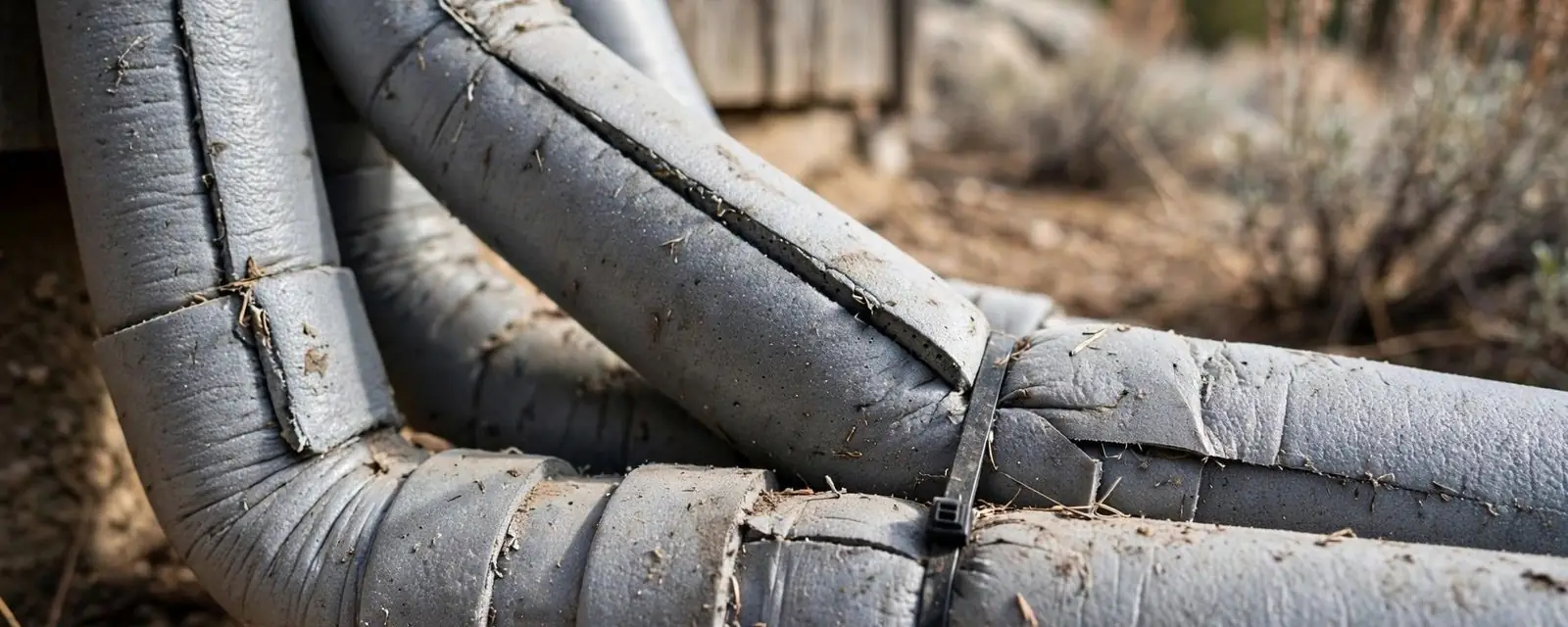
Why tankless units are more sensitive to freezing
A tankless water heater does not keep a tank of warm water on standby. It holds only a small amount of water in the heat exchanger and in the pipes around it. If those fill with ice, the expansion can crack the exchanger, which is an expensive failure.
Many tankless units have built-in freeze protection that runs a heater or the burner when the temperature drops. That only works when the unit has power. A power outage during a cold snap defeats it, which is the case most people forget.
What heat tape does and where it fits
| Item | What it protects | Limit |
|---|---|---|
| Heat tape on supply and outlet pipes | Exposed pipes near the unit | Needs power, will not protect the unit inside. |
| Pipe insulation | Slows heat loss from pipes | Does not add heat on its own. |
| Built-in unit freeze protection | The exchanger | Only works when powered. |
| Draining the unit for winter | Everything | Hot water is off until it is refilled. |
The manufacturer's installation manual is the rule. Heat tape is electrical equipment, so use a listed product and follow the National Electrical Code (NEC) along with the manufacturer's instructions. It states whether heat tape is allowed, what type, and where. Some manufacturers forbid wrapping certain parts or specify a thermostat controlled tape. Follow it.
Where a tankless unit is at risk
- Mounted on an outside wall, even under an eave.
- In an unheated garage, crawlspace or attic.
- With vent terminations exposed to wind.
- On a circuit that can trip during a storm.
The risk is not constant. It spikes on rare cold nights, which is why a unit that has run for years can fail the first hard freeze. If you are planning an install, a heated indoor location avoids the question entirely.
Local note: Beaverton winters are mild, until they are not
News coverage reported burst pipes across the Portland area during the January 2024 cold and ice storm. Most Beaverton winters are mild, which makes freezes surprising, and garages and exterior walls in local houses are often lightly protected. The City of Beaverton has a page on freezing pipes, worth reading before a cold forecast.
Beaverton's water is soft, typically 1.5 to 3 grains per gallon per the City, so scale on the exchanger is a smaller worry than ice. Oregon requires plumbing permits for water heaters, so if you add or move a unit, ask the Beaverton building department about the permit. Hillsboro homes follow the same pattern, see the Hillsboro page.
What to do before a cold night: a checklist for tankless owners
- 1
Check the unit is powered.
Freeze protection needs power. Confirm the breaker and the outlet.
- 2
Look at exposed piping.
Insulate or wrap per the manual.
- 3
Open cabinet doors on exterior walls.
Warm air helps nearby pipes.
- 4
Know your shutoff.
If a pipe splits, you need the main closed quickly.
For service, flushing and installs, see tankless water heater service. If a pipe has already split, burst pipe repair is the page to use.
Types of heat tape and how to choose
| Type | How it works | Good to know |
|---|---|---|
| Constant wattage | Same heat all the time | Needs a thermostat, can overheat if overlapped. |
| Self-regulating | Adjusts heat to pipe temperature | Safer, can be cut to length, usually costs more. |
| Thermostat controlled | Turns on near freezing | Saves power, check the sensor placement. |
Never overlap constant wattage tape on itself. Keep it off plastic pipe unless the label says it is rated for it. Check the cord, the plug and the thermostat each fall. A damaged tape is a fire risk, which is why the manufacturer's rules come first.
Moving the unit is sometimes the better answer
If a tankless unit sits on an exposed wall, heat tape is a patch on a design problem. Relocating the unit to a heated space may cost more upfront and removes the question for good. It also protects the vent path and the gas or electric supply from cold exposure.
A plumber can check where the unit sits, how the pipes run and what a relocation involves. Oregon requires permits for water heaters, so a move is permitted work. Ask the Beaverton building department about your plan.
A simple decision guide
- Unit and pipes in a heated room: no heat tape is usually needed.
- Unit in a garage or on an outside wall: check the manual, add freeze protection and confirm power.
- Long outdoor pipe runs: insulate and use rated tape.
- Away from home in a hard freeze: drain the unit or shut off the main.
When in doubt, ask the installer who set the unit. They know what the manufacturer allows for that model.
Tankless heat tape questions
Only if it or its pipes sit in a place that can freeze, and only as the manufacturer allows. Indoor heated spaces usually do not need it.
Using the wrong type or wrapping the wrong parts can, which is why the manual rules.
Built-in freeze protection and powered heat tape both stop. Draining the unit before a long cold outage is the safe step.
No. It was unusual, but it showed what an unprotected exterior wall or garage can do.
Heat tape alone is minor, but a unit move or install needs a permit. Ask the Beaverton building department.