
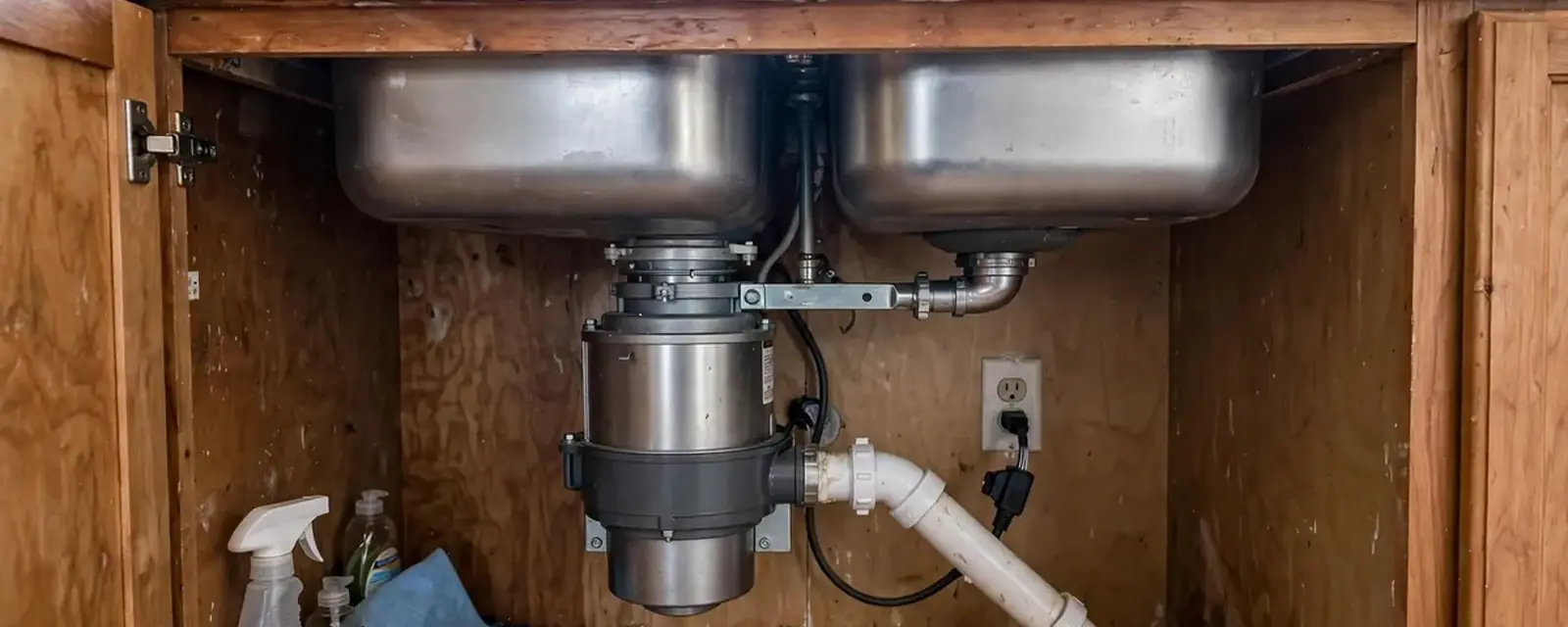
The parts under a double sink with a disposal
Start at the top. Each bowl has a strainer and a tailpiece going down. The disposal bolts to the strainer of one bowl. The other bowl's tailpiece runs to a continuous waste tube that joins the disposal's outlet or the trap arm. From there a single trap leads to the wall drain.
A dishwasher drain hose connects to a small nipple on the disposal's side, with a knockout plug removed when the dishwasher is installed. The hose usually loops high under the counter, or goes through an air gap, to stop dirty water from running back.
How the pieces should be arranged
| Part | Job | Common mistake |
|---|---|---|
| Disposal outlet | Sends ground waste out | Pointed the wrong way, or the gasket is missing. |
| Continuous waste | Joins the second bowl | Too long a run with a sag that holds water. |
| P-trap | Holds a water seal against sewer gas | Installed too low or with a long horizontal run. |
| Dishwasher hose | Drains the dishwasher | No high loop, so water backs up. |
| Vent | Lets air in so the drain flows | Blocked or missing, causing slow drains. |
Plumbing code sets rules for trap distance and venting. The Uniform Plumbing Code (UPC), which Oregon's plumbing code is based on, sets those limits. Ask the Beaverton building department if you change the layout. A swap of like for like usually does not, but adding fixtures might.
Common problems and what they point to
- Both bowls fill when you run the disposal. The clog is past the junction, usually in the trap or beyond, and is a drain problem for drain cleaning.
- Dishwasher water shows up in the sink. The disposal outlet or the line behind it is partly blocked.
- A drip under the disposal. A seal at the top flange, a side crack or a loose connection.
- A smell. Food residue in the disposal or a dry trap.
- Gurgling. A venting issue, which a plumber should test.
If the disposal itself is the problem, see garbage disposal repair.
Local note: older kitchens and what Beaverton plumbers find
Beaverton's housing boom, from about 6,000 residents in 1960 to more than 50,000 in 1990, means plenty of kitchens built then still have the original drain layout. Older traps can be galvanized steel or thin brass that has corroded from the inside, which shows up as a slow drip at a slip joint.
The City's water is soft, typically 1.5 to 3 grains per gallon, so the mineral scale you see in hard-water kitchens is less of a problem here. Grease is the main culprit. Rental kitchens, which are about 52 percent of Beaverton homes, often have disposals that were added later with mismatched parts. If you rent, tell the owner before opening anything. Hillsboro-side kitchens follow the same pattern, see the Hillsboro page.
What a plumber checks on a double sink job
- 1
Trace the flow.
Run water in each bowl and watch for pooling at the junction.
- 2
Inspect the trap and joints.
Check slip nuts, washers and the trap arm slope.
- 3
Check the dishwasher connection.
Confirm the knockout is cleared and the hose has a high loop.
- 4
Test the vent.
A slow drain with a good trap may mean a partly blocked vent.
Installing a disposal under a double sink: the order of operations
- 1
Remove the old strainer and trap.
Shut off water, put a bucket under the trap and disconnect the slip nuts.
- 2
Mount the disposal to the bowl.
The sink flange, gasket and mounting ring hold the unit from below. Tighten the mount evenly.
- 3
Fit the continuous waste.
A tube from the second bowl joins the disposal outlet or a branch tee. Keep a steady downward slope.
- 4
Connect the trap.
The trap arm goes to the wall drain with the right height and slope.
- 5
Hook up the dishwasher hose.
Remove the knockout plug inside the disposal port first, and keep the hose looped high.
- 6
Wire it and test.
A switch-controlled outlet or hardwired circuit powers the unit. Run water and check every joint.
What a plumber adds that a kit does not
Kits assume a standard layout. Real kitchens have a trap that sits too high, a wall drain at an odd height or a dishwasher too far from the sink. A plumber adjusts the layout, tests the vent and removes the guesswork. If you have already installed a unit and it drains slowly or leaks, call and we can inspect it.
Slow double sink or a leak under the disposal? Call to book a visit.
Double sink and disposal questions
The clog is downstream of the junction. Clearing the trap or the line beyond it fixes it.
Usually to a port on the disposal, with a high loop or an air gap, or to the sink drain tailpiece when there is no disposal.
Usually yes, with a continuous waste and possibly a new trap. A plumber checks the trap height and the electrical switch.
Food residue in the disposal or grease in the trap. Cleaning the disposal and the trap often cures it.
Ask the Beaverton building department. A like-for-like swap often differs from a layout change.