
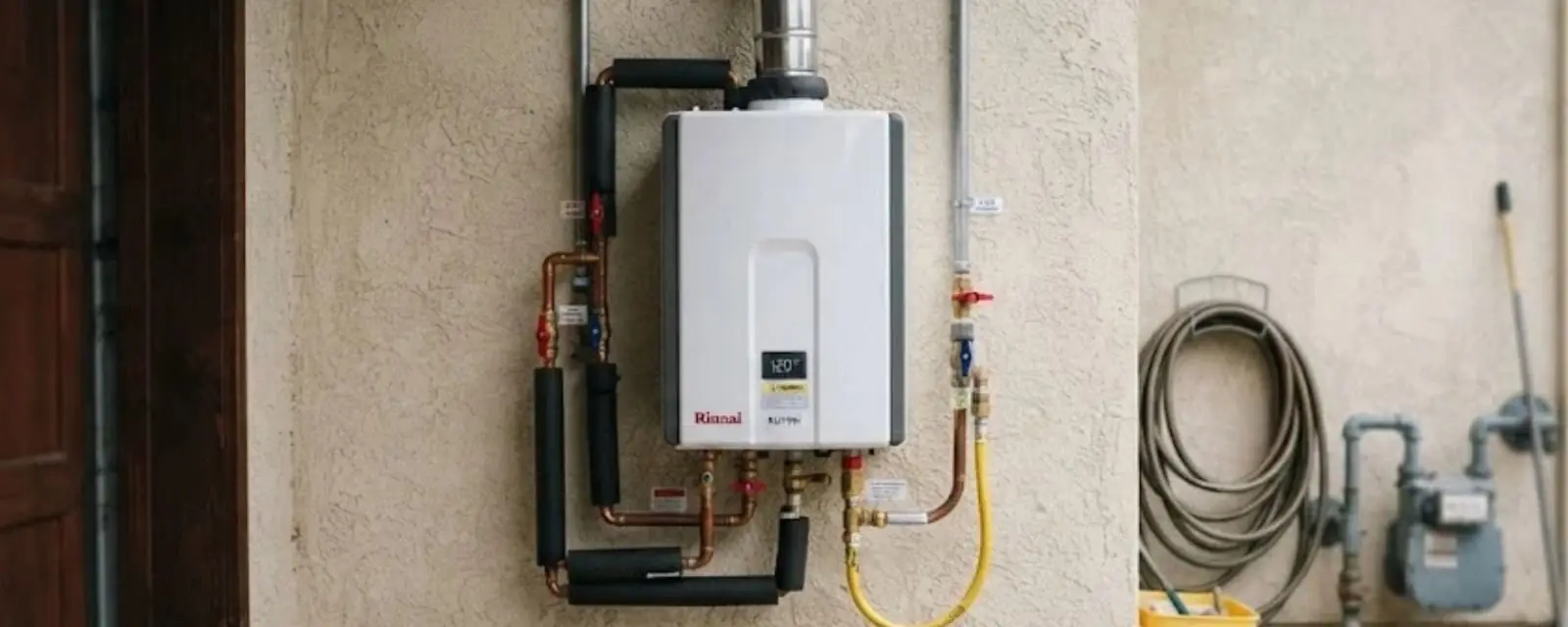
The short answer
Both types exist. Gas tankless units burn natural gas or propane to heat water as it flows through a heat exchanger. Electric tankless units use heating elements and draw a lot of power. A third group, condensing gas models, squeeze more heat out of the exhaust and need a drain for the acidic condensate.
So the question is not whether tankless uses gas. It is which fuel suits your home, and the answer depends on the pipes and wires you already have.
What each type needs from your house
| Gas tankless | Electric tankless | |
|---|---|---|
| Fuel supply | Gas line sized for a high burner load | Large dedicated circuit, often multiple breakers. |
| Venting | Sealed vent to the outside | None. |
| Drain | Condensate drain on condensing models | None. |
| Install complexity | Gas line, vent and sometimes a new line size | Panel capacity is the limit. |
| Best fit | Homes with gas service and room for a vent run | Homes with strong electrical service and no gas. |
The most common surprise on a gas swap is the gas line. A tankless burner uses far more gas at once than a tank burner, so the existing half-inch line may be too small. For electric, an older panel with limited capacity can rule it out.
Which is cheaper to run
It depends on local gas and electricity prices, which change, so check your own bills before deciding. In general, gas heats water more cheaply per unit of energy than resistive electric elements. Heat pump tanks are a separate category that can be very efficient on electricity.
A tankless unit saves the standby loss of keeping a tank hot all day. The savings are real in small households and shrink as hot water use goes up. Ask the plumber for a rough estimate based on your household's usage and your utility's rates. Gas piping and venting for a tankless install follow the Uniform Plumbing Code (UPC) as Oregon has adopted it in the Oregon Plumbing Specialty Code.
Local note: what Beaverton buyers should check first
Oregon's Building Codes Division says plumbing permits are required for water heaters, which includes tankless units. A gas tankless install also touches gas piping and venting, so ask the Beaverton building department what applies to your address before you buy a unit.
Beaverton's water is soft, typically 1.5 to 3 grains per gallon per the City, so a tankless heat exchanger scales more slowly here than in hard-water cities. Annual flushing is still the standard recommendation, as covered on the tankless water heater page. Homes in the Hillsboro area, on the Hillsboro page, have even softer water per that city's report, at 1.21 to 1.86 grains per gallon.
Questions to ask before choosing
- How many fixtures run at once in my household, and can the unit keep up?
- Is my gas line big enough, or what would an upgrade cost?
- Is there a safe vent route to the outside?
- Does my panel have room for the electric model?
- Who pulls the permit, and what does the inspection cover?
If your current tank has failed and you need hot water quickly, compare with a standard tank on the water heater replacement page. A tank is usually faster to install, and you can move to tankless later.
Sizing a tankless unit to your household
Tankless units are rated by how many gallons per minute they can heat to a set temperature rise. Two numbers matter. One is the flow you need at the same time, and the other is how much the incoming water must be warmed. Cold winter ground water needs more heat than summer supply.
| Fixture | Typical flow | Runs together? |
|---|---|---|
| Shower | About 2 gallons per minute | Often two at once. |
| Kitchen faucet | About 1.5 gallons per minute | Sometimes with a shower. |
| Dishwasher | About 1.5 gallons per minute | Often at the same time. |
| Washing machine | About 2 gallons per minute | Often at the same time. |
Add up what runs at once in your busiest hour. If two showers and a dishwasher overlap every morning, a small unit will struggle. The numbers above are rough, so check the actual flow rates on your fixtures. Your plumber can size the unit from them.
Where gas tankless units get tricky
Gas units give off exhaust that must reach the outdoors by a sealed path. The vent run has a maximum length and a limit on elbows, and the vent material depends on whether the model is condensing. A condensing unit also needs a place to drain the acidic condensate, usually through a neutralizer.
Not sure whether your gas line and vent path can handle a tankless unit? Call and describe your setup.
Tankless gas questions for Beaverton homeowners
No. Gas and electric models both exist. Gas units need a gas line and venting, and electric units need a large electrical supply.
Often it needs to be larger, since a tankless burner uses more gas at once. A plumber measures the line and the load.
Often a little, by avoiding standby loss, but gas and electricity prices vary. Check your utility rates and your household's hot water use.
Oregon requires plumbing permits for water heaters. Ask the Beaverton building department about your job.
Soft water scales a heat exchanger more slowly, but annual flushing is still recommended.