
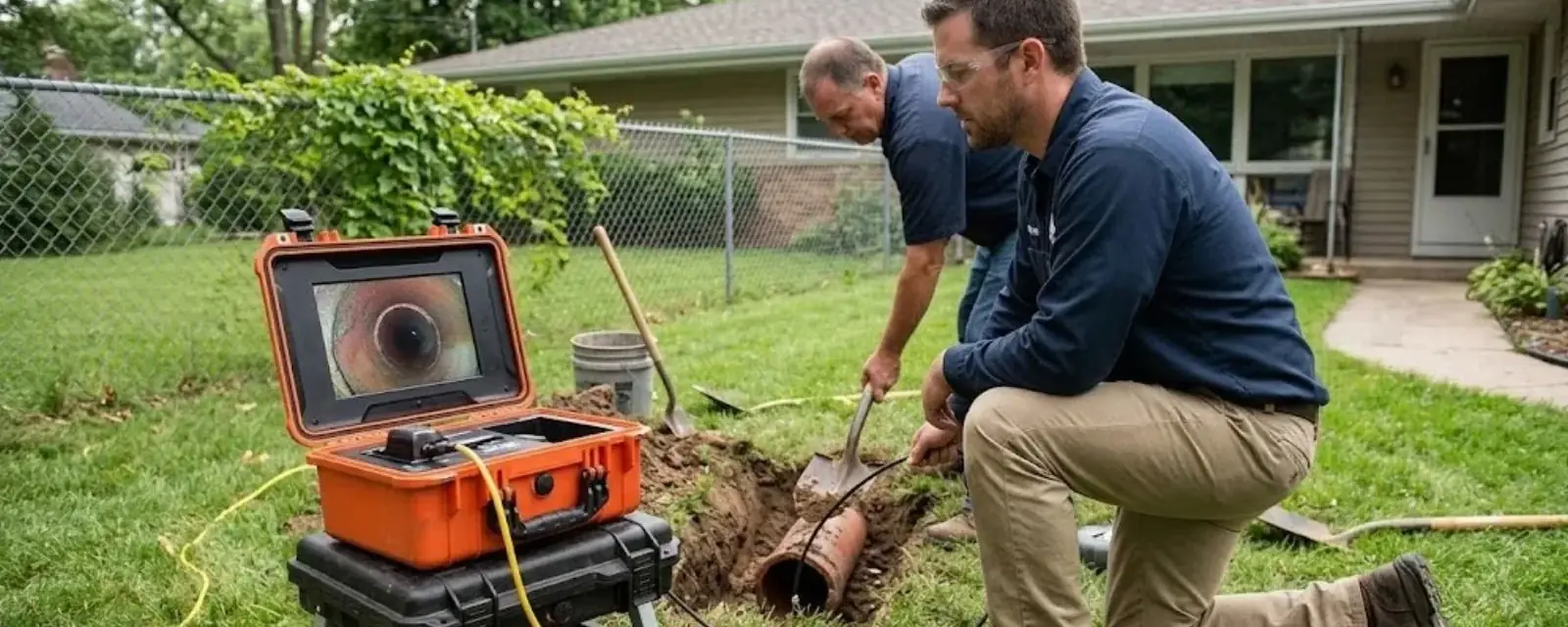
What a camera inspection shows
A waterproof camera on a flexible rod travels through the cleanout and records the pipe. The plumber watches live and records video you keep. What you see tells you whether the problem is a clog, roots, a sagging section or a break.
| What the camera finds | What it means | Typical next step |
|---|---|---|
| Fine roots at joints | Water is escaping at the joint | Cleaning, then lining or spot repair. |
| A belly holding water | Pipe has settled | Monitor or replace the section. |
| Offset joint | Pipe sections no longer line up | Spot repair or replacement. |
| Cracked or crushed pipe | Structural failure | Repair or replacement, see sewer line repair. |
| Heavy grease or debris | Blockage, not damage | Cleaning or jetting. |
When to book an inspection
- A drain clogged twice in a short stretch.
- You are buying a house with a lateral that predates the 1990s.
- Slow drains with no clear cause after cleaning.
- A soggy patch in the yard, or a sewer odor outside.
- Before a remodel or any digging near the line.
The home-buying case is common. About half of Beaverton homes are rentals and many are older. A camera costs far less than a surprise lateral repair after closing.
How the visit works
- 1
Find the access point.
A cleanout is best. Without one the plumber may use a toilet or a roof vent.
- 2
Clear if needed.
Heavy debris may need cleaning first, or the lens will not show the pipe.
- 3
Run the camera.
The plumber records the whole run from house to the property line or main.
- 4
Review the video with you.
We point out what each defect is and its position. You keep the recording.
Using your video with Clean Water Services
Clean Water Services guidance says the owner is responsible for the lateral, and CWS responsibility begins at the public mainline. It repairs structural defects in laterals that run through the public right of way, such as cracked pipe, open joints and root intrusion. A belly is not treated as structural.
CWS asks owners to submit video to its field operations when a defect may be in its area. That makes a clear recording useful for more than your own decisions. We note footage marks so the location can be found.
For permits on any repair, ask the building department of your city or county. We do not quote rules we cannot confirm. Repairs themselves follow the Oregon Plumbing Specialty Code, which is based on the Uniform Plumbing Code (UPC).
What affects the price
- Line length. Longer runs take more time.
- Access. A cleanout saves effort.
- Cleaning first. A blocked pipe has to be cleared to be seen.
- Locating. Marking the depth of a defect on the surface adds time.
- Report. The video is yours, and written notes come with the visit.
Inspection itself is not usually an insurance claim. Call for a clear price, since we state it before work starts.
Reading the video: what the plumber looks for
A camera view looks confusing until you know the landmarks. The plumber watches for the pipe material, the joints, the slope and anything in the water. Each tells a different story.
- Clay pipe has regular joints every few feet and tends to show roots at those joints.
- Cast iron shows rough, scaled walls and can be heavily tuberculated.
- Plastic pipe is smooth and shows breaks as clean cracks or crushed sections.
- Standing water in the pipe suggests a belly, and the length of the pool tells you how big.
We stop the camera at each defect and note how far it is from the cleanout, so a repair crew knows where to dig.
Book an inspection
An inspection is quick to schedule, and a same-day window is offered when one is open. If a line is already backing up, say so, because it needs cleaning first.
Want to see what is inside your sewer line? Call to book a camera inspection.
Sewer camera inspection questions
A typical house takes an hour or so once the plumber has access. Heavy cleaning first or a long lateral adds time.
It helps a lot. Without one, the plumber may need to remove a toilet or use a roof vent to enter the line, which takes longer.
Yes. Roots at joints show clearly on video, including how dense they are and how many joints they have entered.
A locator can trace the camera head and mark its depth on the surface, which tells you where to dig for a spot repair.
Yes. Many Beaverton homes were built between the 1960s and 1990s, and a lateral that old is worth seeing before closing.