
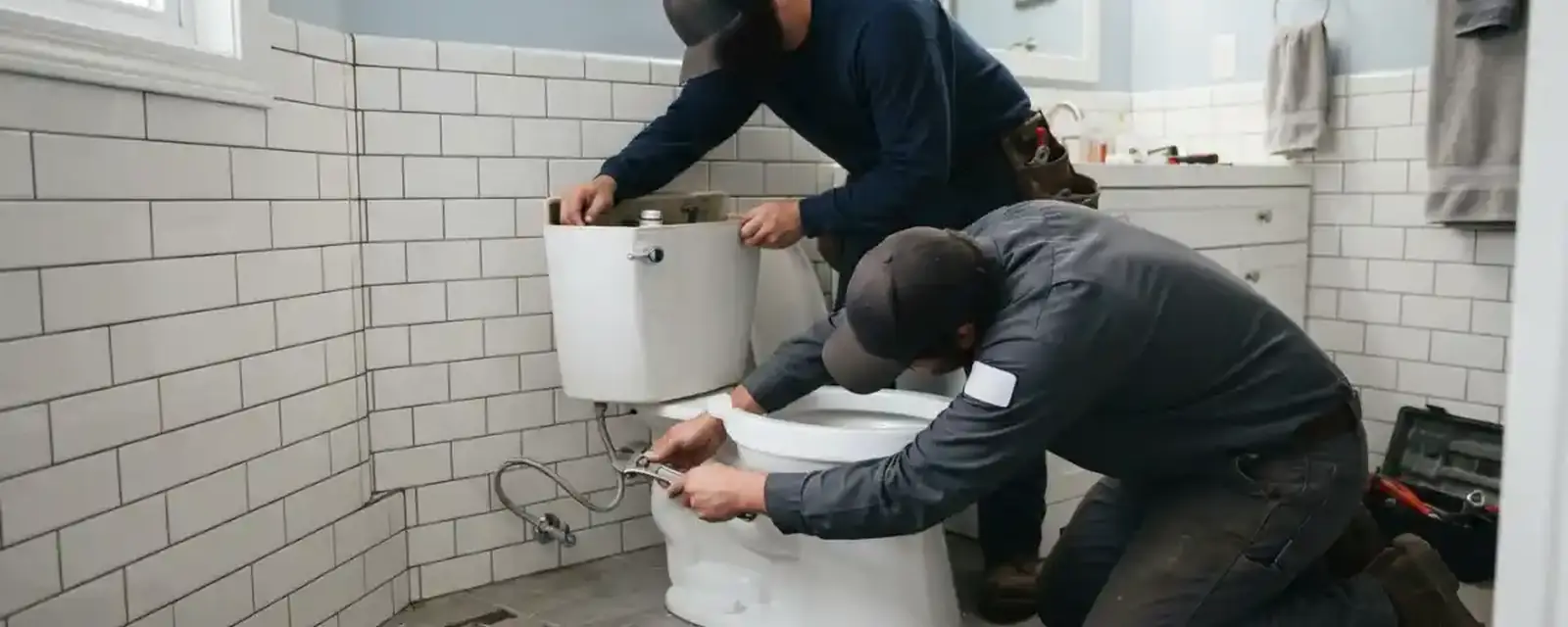
Why flange height matters
The toilet flange anchors the toilet to the floor and connects it to the drain. The toilet's horn pushes into a wax ring that sits on the flange. If the flange is too low, the ring cannot compress enough to seal. If it is too high, the toilet sits crooked or will not seat on the floor.
The general rule is that the flange's top should sit on the finished floor, or slightly above it. Check your local code and manufacturer instructions, and ask the Beaverton building department if you are unsure. Oregon's plumbing code is based on the Uniform Plumbing Code (UPC).
How to measure it
- 1
Remove the toilet.
Shut off water, drain and unbolt it, then set it on a towel.
- 2
Lay a straightedge.
Place a straight board across the floor next to the flange.
- 3
Measure the gap.
Compare the flange top to the finished floor surface.
- 4
Check the flange itself.
Look for cracks, rust, broken bolt slots and loose screws into the subfloor.
Fixes by the size of the gap
| Situation | Fix | Notes |
|---|---|---|
| Flange slightly low, under about a quarter inch | Thicker wax ring or a flanged ring | Test the seal after setting. |
| Flange moderately low | Flange extender or spacer ring | Set on a clean, solid flange. |
| Flange far below the floor | Replace the flange or cut in a new one | Often means pipe work, call a plumber. |
| Flange higher than the floor | Cut the flange down or notch the floor | Rare, usually after a floor was removed. |
| Cracked or corroded | Repair ring or full replacement | Do not set a toilet on a broken flange. |
A flange that is loose, rotted into the floor or attached to a damaged pipe needs a plumber, and a toilet that leaks repeatedly is covered by toilet repair.
Why remodels throw it off
Most problems show up after a floor is redone. Tile, a new layer of plywood or heated flooring raise the floor by half an inch or more, and the flange stays where it was. The toilet gets set on top, the ring does not reach, and a slow leak starts that rots the subfloor.
If you plan a remodel, tell the tile installer that the flange has to be raised to match, and have the plumber do it before the toilet goes back. See plumbing installation for remodel hookups.
Local note: renovated Beaverton bathrooms
Beaverton's growth from about 6,000 residents in 1960 to more than 50,000 by 1990 left many bathrooms that have been renovated at least once. Flooring changes are the common cause of low flanges, so if your house has had a bathroom remodel, this is the first thing to check when a toilet leaks.
Since about 52 percent of homes in Beaverton are rented, tell the owner if you notice a rocking toilet. The flange and subfloor are the owner's repair. For work on the Hillsboro side, the Hillsboro page explains how our dispatch covers that area.
Tools and parts to have ready
- A new wax ring or a wax-free seal sized for your toilet.
- New closet bolts and washers, since old ones corrode.
- A flange extender, spacer ring or repair ring.
- A putty knife, gloves and rags.
- Shims for leveling the base after it is set.
Buy the parts after you measure, not before. Flange height and condition tell you which ones you need. A flange repair ring costs little, and a toilet that is set badly twice costs a floor.
Signs the floor itself is the problem
Press around the toilet base with your hand. A spongy spot, dark staining or a smell of mildew means water has been getting into the subfloor. A flange cannot hold screws in rotted wood, so the floor needs repair first. A plumber can find the damage and tell you if another trade is needed.
Toilet rocking or leaking at the base? Call and a plumber will check the flange.
A quick rule for tile jobs
If you are tiling a bathroom floor, tell the installer before the toilet comes up. Measure the flange against the planned finished floor and raise it first. Doing this in the right order costs a spacer ring. Doing it after the toilet leaks costs a new subfloor.
Types of flanges you may find
- Cast iron: heavy and durable, can rust at the bolt slots.
- PVC or ABS: common in newer work, glued to the drain pipe.
- Brass or stainless: strong, often found on cast iron stacks.
- Repair rings: steel or plastic rings that reinforce a cracked flange.
Each type has its own repair, so identify yours before buying parts. A plumber can tell at a glance.
Toilet flange height questions
Generally the top of the flange sits on the finished floor, or slightly above it. Check manufacturer instructions and local code.
It is not a good fix. The seal can fail. Use a flanged ring or an extender made for the purpose.
Check the flange height, bolts and floor. Shims can level the base, but a rocking toilet often points to a flange or floor problem.
A repair ring can fix a small crack. A rusted or loose flange on cast iron often needs a plumber.
Yes, if it leaks. A soft floor around a toilet is a warning sign.