
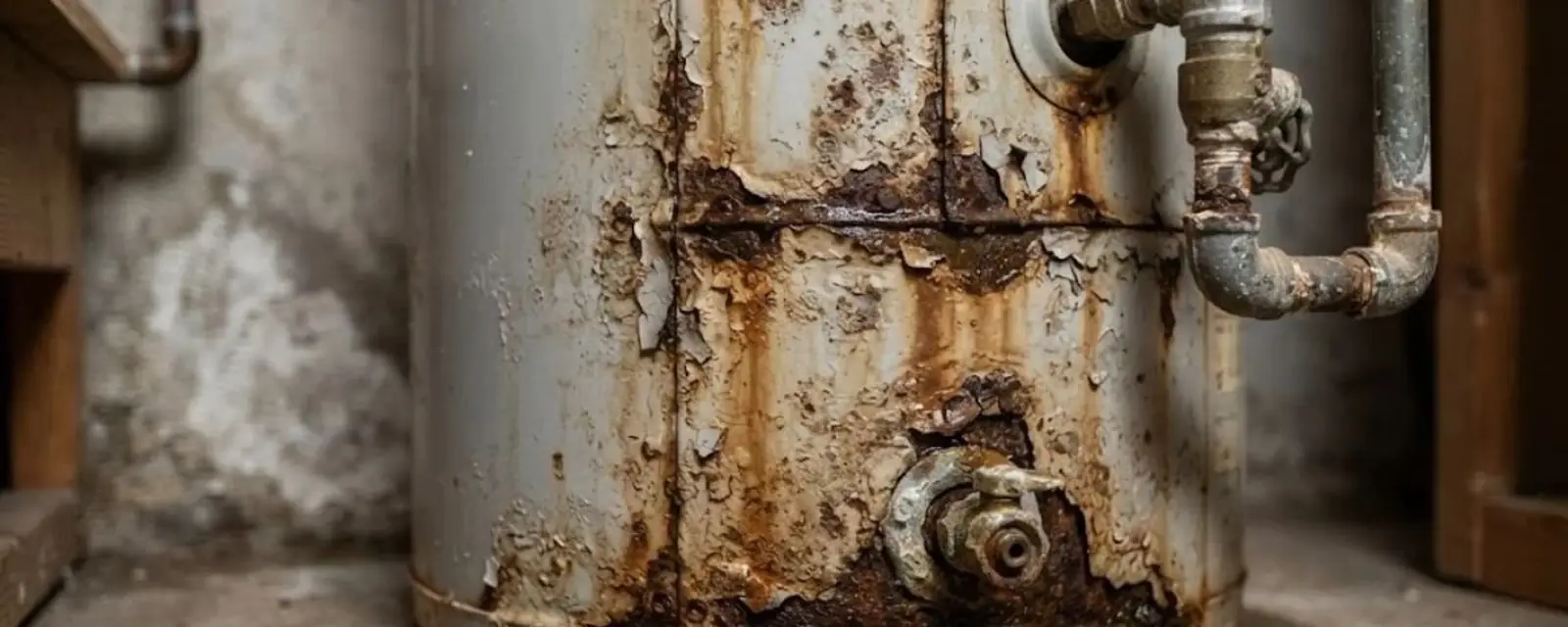
Tank repair versus tank failure
The tank itself is a steel vessel lined with glass. When it develops a leak through the steel, it cannot be repaired. That is a failed tank and the unit needs replacement. Many other leaks and faults come from parts attached to the tank, and those can be fixed.
So the first job is to find where the water is really coming from. Dry the area, then watch for a few minutes with a flashlight.
Leak locations and what they mean
| Where the water appears | Usual cause | Fixable? |
|---|---|---|
| Top connections | Loose or corroded fittings | Yes, often tighten or replace a fitting. |
| Relief valve or its pipe | Pressure, temperature or a failing valve | Yes, replace the valve or add an expansion tank. |
| Drain valve at the bottom | Worn valve | Yes, replace the valve. |
| Heating element gasket on electric units | Failed gasket | Yes, replace it. |
| Tank body or base | Steel has failed | No, replacement. |
| Condensation drips | Moist air on a cold tank | Not a leak, check the insulation and venting. |
For a leaking tank body, see water heater replacement. For parts, see water heater repair.
Repairs that extend a tank's life
- Replace the anode rod. It corrodes first so the tank does not.
- Flush sediment to reduce noise and stress.
- Replace a faulty thermostat or element.
- Replace a weeping relief valve.
- Add an expansion tank if the system is closed.
The anode rod is the single best life extender. Many tanks fail early because it was never checked. A plumber can inspect it during a flush.
Local note: Beaverton's soft water and the permit rule
Beaverton's water is soft, typically 1.5 to 3 grains per gallon per the City's report, so scale is less of a driver of tank failure here than in hard-water cities. That tends to extend element life, though it does not stop an anode rod from wearing out. Groundwater sources are harder at around 5 grains per gallon, according to the City's report. Your address may be on a different mix.
If repair is not enough and you replace the tank, Oregon's Building Codes Division requires a plumbing permit for water heaters, and an owner who does the job must pull it. Ask the Beaverton building department about repairs that do not replace the tank. To check a plumber's license, use the state's public search. Oregon's plumbing code, the Oregon Plumbing Specialty Code, is based on the Uniform Plumbing Code (UPC). Hillsboro-side homes can see the Hillsboro page.
When to repair and when to replace
Use the age and the cost. A young tank with a bad thermostat is a repair. An old tank with a leaking body is a replacement. A middle-aged tank with a costly repair is a judgment call, and the plumber should give you both prices.
If it is leaking now, close the cold valve above the tank, cut power or gas and call. A leaking heater can ruin a floor in an hour.
A yearly maintenance routine that avoids most repairs
- 1
Test the relief valve.
Lift the lever briefly to confirm water flows and the valve reseats. If it will not reseat, replace it.
- 2
Flush a few gallons from the drain.
Clear sediment from the bottom until the water runs clean.
- 3
Check for corrosion and moisture.
Look at fittings, the top of the tank and the floor for rust and drips.
- 4
Set the thermostat sensibly.
A moderate setting reduces scalding risk and wear.
- 5
Inspect the anode rod every few years.
A heavily eaten rod is a sign the tank needs protection.
When a leak is an emergency
A steady leak from the tank body, water near electrical wiring or a gas smell is urgent. Close the cold valve, cut power or gas and keep people away. A gas smell means leave the building and call 911 or the gas utility first.
Tank leaking and you need a plumber now? Call the 24/7 line.
Signs a repair will not last
- Rust-colored hot water that clears when you run cold.
- A tank that is well past its expected life and needs several parts.
- Moisture at the seams of the tank jacket.
- A relief valve that discharges again soon after replacement.
Any of these suggests the money is better spent on a new tank, and a plumber should show you both sets of numbers.
What a repair visit includes
The plumber checks the fuel supply, the venting and the controls, finds where water is escaping and tests the relief valve. They then explain what failed, what a repair costs and whether the tank is worth keeping. You get the price before the work begins, and the old part is yours to see if you ask.
Having the make, model and age ready when you call speeds this up. The label on the side of the tank lists the serial number, which usually encodes the build date.
Water heater tank repair questions
If water comes through the tank body, no. If the leak is at a fitting, valve or gasket, usually yes.
Dry everything and watch. Water at the top usually means a fitting or valve. Water pooling under the base with dry fittings usually means the tank.
It corrodes in place of the tank walls. Replacing it on schedule can extend the tank's life.
Oregon requires permits for water heaters, usually on replacement. Ask the Beaverton building department about your repair.
Water leaks are the same, but a gas smell is an emergency. Leave and call 911 or the gas utility first.