
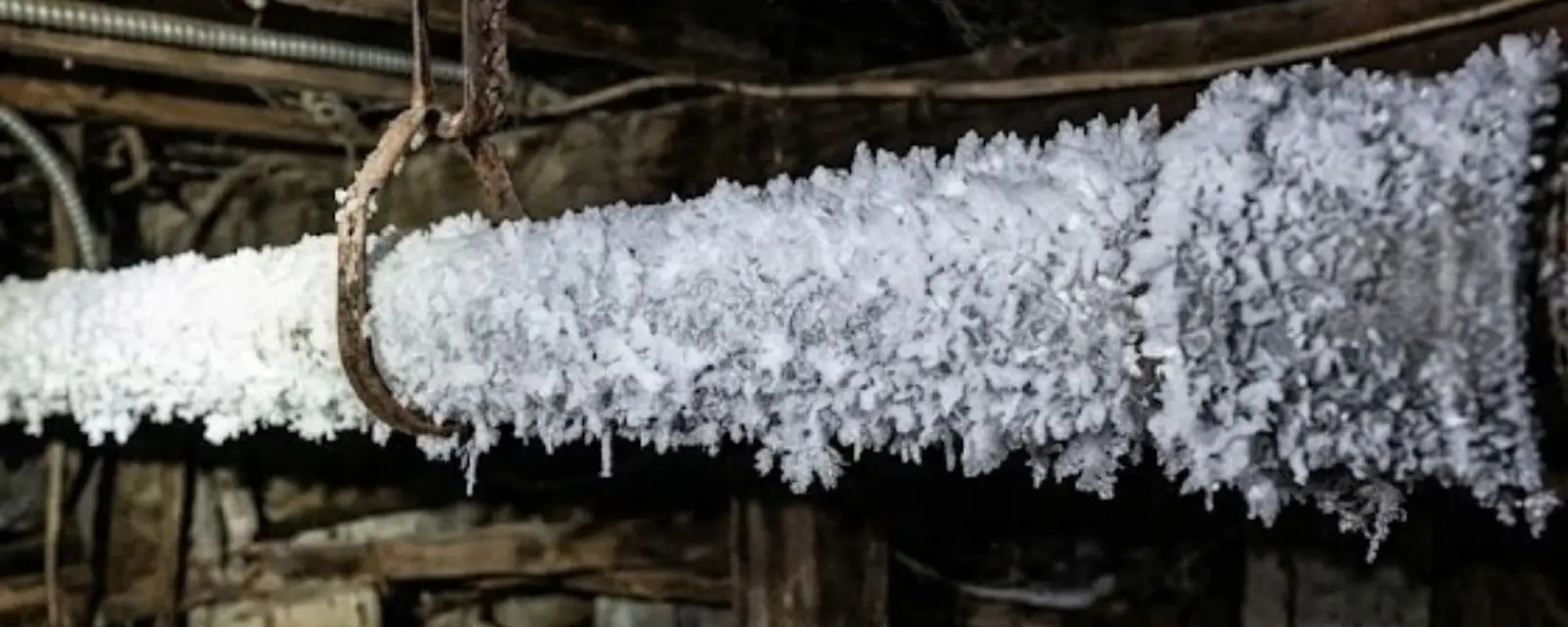
Before the freeze: a one-hour prep
- Disconnect garden hoses and cover outdoor spigots.
- Open cabinet doors under sinks on exterior walls so warm air reaches the pipes.
- Let a faucet drip on the coldest night, on the side of the house that is most exposed.
- Insulate pipes in garages, crawlspaces and attics with foam sleeves.
- Find your main shutoff and make sure it turns.
The City of Beaverton has a page on freezing pipes. Read it before cold weather arrives.
Spotting a frozen pipe
A frozen pipe shows up as a faucet that runs weak or not at all in freezing weather. Frost on the pipe, a bulge or a pipe that is very cold to the touch are other signs. If only one fixture is affected, the freeze is localized.
Open the faucet fully. Water has to be able to escape as the ice melts, and an open faucet also shows when flow returns.
Safe thawing, step by step
- 1
Open the faucet.
Relieve pressure so the melting ice has a path.
- 2
Apply gentle heat.
Use a hair dryer or a heating pad on the pipe, starting near the faucet and moving toward the freeze.
- 3
Never use an open flame.
A torch can start a fire inside the wall or damage the pipe.
- 4
Check for splits.
Look along the pipe for cracks or drips, and check the ceiling and walls below.
- 5
Know when to stop.
If you cannot find or reach the frozen section, call a plumber.
If a pipe has already split, close the main and follow the steps on burst pipe repair. A replaced section is done with materials the Oregon Plumbing Specialty Code, based on the Uniform Plumbing Code (UPC), allows.
Local note: what Beaverton's mild winters mean for your pipes
News coverage reported burst pipes across the Portland area during the January 2024 cold and ice storm. Because hard freezes are rare in Beaverton, many garages, crawlspaces and exterior walls are lightly insulated and pipes there are exposed. The City's guidance on freezing pipes is written for exactly this.
Beaverton's water is soft, typically 1.5 to 3 grains per gallon per the City, which has nothing to do with freezing but means fewer scale problems inside pipes. If your home is among the many built from the 1960s through the 1990s, check where pipes run along exterior walls. About 52 percent of homes are rented, so renters should know the shutoff and tell the owner about drafty spaces. For Hillsboro-side addresses, see the Hillsboro page.
When to call a plumber
Call when you cannot find the frozen section, when it is inside a wall, when you see any split or drip, or when several fixtures have lost water. A pipe that thawed may have cracked and leak only when the pressure returns, so watch it for a few hours after it thaws.
If the meter keeps running after a freeze, leak detection helps find the crack. Repeated freeze failures on old pipe may point to repiping.
Which pipes in a typical house freeze first
| Location | Why it freezes | Prevention |
|---|---|---|
| Outdoor spigot and its supply | Exposed to wind and air | Disconnect hoses and cover the spigot. |
| Garage walls and ceilings | Unheated, often poorly insulated | Foam sleeves, keep the door closed. |
| Crawlspace runs | Cold air under the floor | Insulate the pipes and seal vents on cold nights. |
| Exterior wall under a sink | Wall holds little heat | Open the cabinet doors. |
| Attic lines | Above the insulation layer | Insulate on top, not under, the pipes. |
Walk through the house once and note where pipes are near an outside wall. A short list of those spots makes a cold forecast a calm event instead of a scramble.
If you will be away during a cold spell
An empty house is the worst case, because a split pipe runs until someone notices. Before you leave, set the heat no lower than a safe minimum, ask a neighbor to check, and consider shutting off the main and draining the lines. A smart water sensor under a sink or near the water heater can alert your phone.
Pipe already split or a fixture dead after a freeze? Call and say so.
What a thaw does not fix
Thawing restores flow. It does not tell you whether the pipe cracked. Ice can split a pipe along its length while still plugging the leak, and the water only shows when the ice melts and pressure returns.
Watch the pipe, the ceiling below it and your meter for several hours after the thaw. A fixture that runs normally and a meter that stops when all water is off are the two signs that you came through clean.
Frozen pipe questions for Beaverton homes
Water freezes at 32 degrees Fahrenheit, but pipes in exposed spaces can freeze when the air around them stays below that for hours. Wind and poor insulation make it worse.
Yes, with the faucet open and no standing water near the cord. Never use an open flame.
On the coldest nights, a slow drip on exposed lines helps keep water moving. It uses a little water.
Look where the water line enters the house, often a garage or crawlspace. Test it before you need it.
Close the main and call. Freeze damage often shows only when the water returns.