
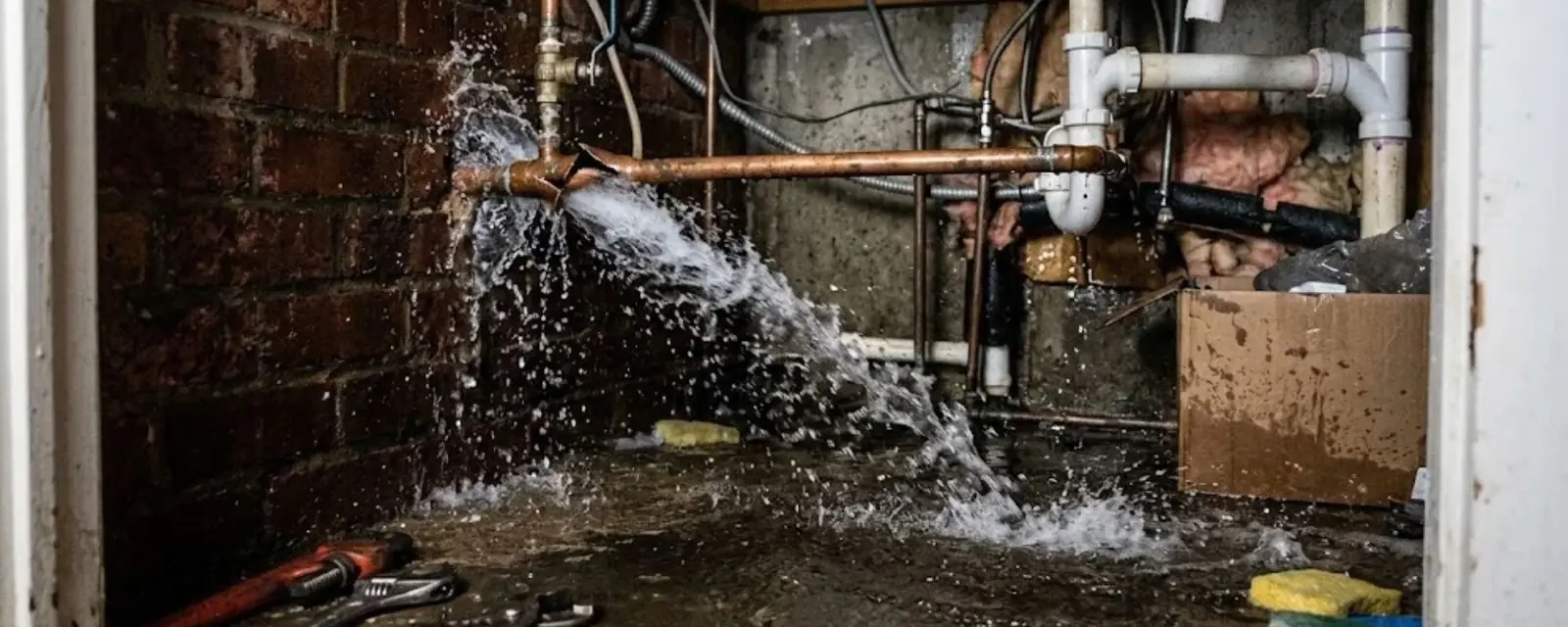
The repair, in the order it happens
- 1
Stop the water.
The main shutoff is closed and the lines are drained. Nothing else can start until the flow stops.
- 2
Find the break and the cause.
The plumber looks at the split, checks nearby pipe and decides whether it is freeze, age or pressure.
- 3
Cut out the damaged section.
The failed pipe is removed back to sound material.
- 4
Install new pipe and fittings.
Copper, PEX or another approved material is joined with the right fittings.
- 5
Pressure test and restore water.
Water is turned on slowly and every joint is checked.
- 6
Document the cause.
A written note of what failed helps your insurance claim.
If you are in the middle of one right now, the emergency steps are on the burst pipe repair page.
What makes one repair bigger than another
| Factor | Small repair | Larger repair |
|---|---|---|
| Pipe location | Open crawlspace or basement | Inside a finished wall or ceiling. |
| Number of breaks | One split | Several along the same run. |
| Pipe material | Copper or PEX | Old galvanized that fails at every joint. |
| Cause | A single freeze event | Corrosion across the system. |
| Water damage | Contained | Spread through multiple rooms. |
When several breaks appear on an old line, the honest question is repair versus repiping. We lay out both.
Insurance: what to do while the pipe is being fixed
- Call your insurer as soon as water is stopped, and ask what documentation they need.
- Photograph every damaged room and item before cleanup.
- Keep receipts for emergency repairs and temporary housing.
- Ask the plumber for a written description of what failed.
- Do not throw out damaged items until the adjuster has seen them or approved.
Sudden bursts are commonly the kind of loss home policies address, while wear and tear often is not. Policies differ, so read yours or call your agent.
Local note: what Beaverton homes tend to burst from
News coverage from the Portland area reported burst pipes during the January 2024 cold and ice storm. Beaverton winters are usually mild, so garages, crawlspaces and exterior walls in local houses are often lightly insulated and the pipes there are the ones that split.
The City of Beaverton has a page on freezing pipes, and it is worth reading before a cold forecast.
Soft water, typically 1.5 to 3 grains per gallon per the City's report, means scale is rarely the cause of a burst here. Age is. The city grew from roughly 6,000 people in 1960 to over 50,000 in 1990, so many houses have 35 to 65 year old plumbing. If you rent, tell the owner right away. About 52 percent of Beaverton homes are rented. Homes on the Hillsboro side can see the Hillsboro page.
After the repair: drying and follow-up checks
Fixing the pipe stops the water. Drying the house prevents the second problem. Wet drywall, insulation and carpet pad can grow mold within a couple of days, so extraction and drying should start fast, usually by a restoration company.
Watch your meter for a day. If it runs with everything off, another leak exists, and leak detection can find it. Keep an eye on the ceiling and walls for stains in the following weeks. Repair materials and joints follow the Oregon Plumbing Specialty Code, which is based on the Uniform Plumbing Code (UPC).
Questions to ask the plumber before work starts
In an emergency it is easy to say yes to everything. A few questions protect you without slowing the repair down. Ask them while the plumber looks at the break.
- What caused the failure, and is the rest of the pipe sound?
- What material will the new section be, and does it match the old pipe?
- Is the price for the repair only, or does it include checking other connections?
- Will you pressure test the line before leaving?
- Does any part of this work need a permit, and who gets it?
A good plumber answers plainly and writes down the findings. If the answers are vague, you can ask for a second opinion once the water is stopped. Verify the plumber's license with the Oregon Building Codes Division public search at any time.
A worked example: what a typical garage freeze split looks like
Picture a copper supply line along the garage wall that splits after a cold night. Water sprays when the heater cycles on and the tap opens. The owner closes the main, drains the line and calls. The plumber cuts out the split, sweats in a new section with couplings and wraps the pipe in foam insulation.
The repair itself is short. The follow-up matters more. The plumber checks the nearby pipe for hairline cracks and shows the owner where the line sits against the cold wall. That conversation is why the same pipe does not split again the next winter. If several runs were exposed, ask about moving them or insulating the whole wall.
Burst pipe repair questions
A simple accessible split can be fixed in a few hours. Pipes behind finished walls or several breaks take longer. The plumber can tell you after seeing the damage.
Sudden bursts are commonly covered for the resulting water damage, but policies differ. Photograph everything and call your insurer.
Small repairs often do not, but ask the Beaverton building department about your situation.
Corrosion, high water pressure and a failed fitting can all cause bursts. The plumber checks the pressure and the pipe condition.
Not always. One freeze split on sound pipe is a repair. Repeated failures on old pipe are a reason to discuss repiping.